
When there is a need to implement a luminaire with a light source that has non-standard requirements, it becomes reasonable to develop an LED module with unique lighting properties. Some specialized applications have specific requirements regarding the wavelengths generated by the source.
One example is signaling lighting fixtures, in which specific colors are lit in appropriate sequences to provide information or warnings. Integrated multicolor LED chips, such as RGB, are also often used for this purpose. Combined with optical and mechanical elements, they perform both lighting and design functions. Depending on the assumptions made, specially designed LED control electronics allow the advantages of the technology to be exploited and non-standard colors to be obtained by mixing them.
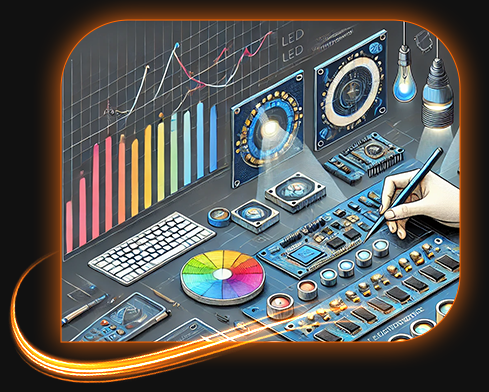
We regularly participate in training courses and industry meetings where representatives of renowned manufacturers present new components in their product ranges. During research and development work on new products, we also draw on the support of application engineers. This ensures that the final product has LEDs that are perfectly matched to the requirements of the project.


Although it is difficult to imagine, specialized lighting research systems have several to several dozen separately controlled LED channels, which enable very precise calibration of the spectral distribution of light generated from an LED source.

Multi-channel LED module for specialized applications
A light source with a control system, implemented in LED technology, enabling the generation of specific lighting conditions on the work surface for specialized vision testing.
Selection of LED chips, design of an individual LED module integrated with the control system, powered by 5 V DC, possibility of adjusting the light flux using the PWM method, creation of a simple and intuitive system for designing sequences and programming the module.
The investor’s expectation was to create a specific light source that would provide specific lighting conditions for conducting research and collecting data in the form of images recorded by a camera. The assumption included the ability to generate light of a specific wavelength, no restrictions on control, integration of the module with the camera, and the ability to independently design light sequences and upload them to the module. We created an LED light source that uses several wavelengths and allows individual control of each of the 100+ diodes in terms of time and brightness. In addition, we designed communication for integration with additional equipment via an external interface. Light sequences are programmed using a simple spreadsheet.
The LED module is capable of generating 1,000 different light sequences in one second.

If you are wondering whether our services meet your needs, please use the form on the right and tell us about your idea. The initial analysis is non-binding and will allow us to quickly determine whether and how we can help you achieve your goals.
We provide a range of engineering services in the field of electronics and mechanics, focused on LED technology, at every stage of the production process. Whether you need support at all stages of the process or only at certain stages, we offer our knowledge, experience, and technological resources.