
Products designed for color adjustment usually use an integrated chip or three separate LED chips emitting red, green, and blue light. The intensity of each LED in the RGB array can be controlled independently, allowing for precise and smooth adjustment of the resulting color and its intensity using the phenomenon of additive synthesis.
In a theoretical model, the superposition of all three components produces the impression of white light. In practice, this depends on many factors, including the psychophysiology of vision, i.e., how our eyes perceive the superimposition of different wavelengths. For this reason, in the control systems we design, we use advanced features, including those that allow the resulting color to be calibrated to specific needs, white balance, and dimming curve adjustment.
Advances in technology offer many versatile possibilities for color lighting design and lighting innovation. Many consumer electronics manufacturers, including TV, tablet, and smartphone manufacturers, use similar technology. What’s more, RGB+ is widely used (and applied by PHC) in stage, signal, architectural, and effect lighting.
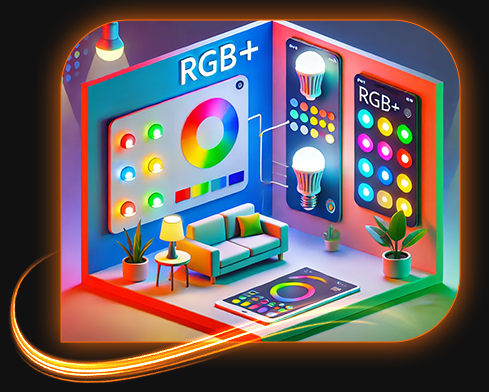
Lighting technology increasingly uses various mutations of RGB solutions, combined with additional chips that increase brightness, energy efficiency, and color consistency. The most popular ones include:
– RGB+W – a set of three chips representing wavelengths perceived as red, green, and blue, combined with a diode emitting light visible as white, with a selected color temperature;
– RGB+WW+CW – RGB combined with two additional white light chips, one with a color temperature defined as warm, the other as cool;
– RGB+A – RGB combined with an additional diode emitting light perceived as amber.
Extensive, multi-channel light sources require the use of appropriate power supply and control systems. Creating individual control algorithms in combination with event-based logic and communication protocols is one of the most exciting challenges we undertake. Therefore, if you are wondering how to approach this in your project, take advantage of the paths we have paved at PHC.
Let’s not forget about a properly selected or individually designed optical system, which allows us to send light exactly where we need it, increasing efficiency and saving energy, while reducing light pollution. Would you like to learn more about this topic? We are at your disposal.

LED module for fountain luminaire
The challenge set by the investor was to create a functional LED module that would not only enable winning tenders in a highly competitive market, but also give public spaces a new look thanks to smooth color spectrum adjustment and dynamic control. Another important goal was to simplify the installation process for installers and reduce the time needed for programming and configuring the luminaires to a minimum. An additional difficulty was the specific mechanics of the luminaire, which used stainless steel, complicating heat management in the luminaire.
Development of advanced thermal protection that protects the light source from overheating, design of an individual LED module in RGB+W technology, based on a set of four diodes emitting red, green, blue, and white light. In addition, development of an RS485-based control protocol enabling the connection of luminaires in any topology, use of the RDM protocol for luminaire programming.
The LED module design required the use of an aluminum substrate and the placement of a large number of components on a small board area. To achieve the color system goal, we selected LEDs with carefully selected wavelengths to cover the entire spectrum of colors in the visible light range thanks to smooth 16-bit PWM control. The color assembly was additionally equipped with a diode generating light perceived as warm white, which allowed us to obtain beautiful pastel shades. For communication, we used a custom-developed protocol based on RS485 transmission with built-in terminators, allowing the luminaires to be connected in any topology, bypassing the rules dictated by the DMX protocol. In addition, through the RDM protocol, we enabled remote identification, configuration, and programming of the fixtures, which was appreciated by installers, for whom it became irrelevant how they connected the fixtures and in what order they were mounted at the installation site. The most difficult challenge to solve was heat management in the luminaire, whose housing acted like a furnace, and the temperature inside the luminaire could rise even after the power was turned off. We thoroughly analyzed the characteristics of thermal changes in stainless steel and designed a thermal protection system that took this dynamic into account based on trends. As a result, the electronics and LEDs installed in the luminaire are also protected in applications where the luminaire is installed for architectural purposes, without active water cooling.
LED module diagnostics via the RDM protocol, recording the LED module’s operating history. This solution allows for accurate identification of service issues, without the possibility of the customer bending the facts.
If you are wondering whether our services meet your needs, please use the form on the right and tell us about your idea. The initial analysis is non-binding and will allow us to quickly determine whether and how we can help you achieve your goals.
We provide a range of engineering services in the field of electronics and mechanics, focused on LED technology, at every stage of the production process. Whether you need support at all stages of the process or only at certain stages, we offer our knowledge, experience, and technological resources.